Understanding the Founding Fathers: An Enquiry into the Indian Republic's Beginnings by Rajmohan Gandhi
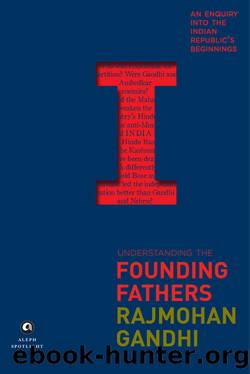
Author:Rajmohan Gandhi [Gandhi, Rajmohan]
Language: eng
Format: azw3
ISBN: 9789383064243
Publisher: Aleph Book Company
Published: 2016-02-01T00:00:00+00:00
How Independence was Gained
According to Anderson, Indian independence was a gift the British gave to India after being battered by the Japanese in World War II (pp 45-48). He brushes away the freedom movement inside India and dismisses as failures all the satyagrahas from 1917 to 1942.
Satyagraha had not been a success: each time Gandhi had tried it, the British had seen it off (p 45).
Britons closer in space and time to the Indian struggle offered a different appraisal of the satyagrahas in which hundreds of thousands risked death, faced beatings, and spent periods in prison, when breadwinners were locked away and deaths, marriages and births took place without loved ones at hand. Below are three verdicts from the Empireâs guardians.
The first assessment was offered after the Non-Cooperation Movement, launched in 1920, was suspended by Gandhi in 1922 (after demonstrators in eastern UP killed twenty-two policemen). That movement saw unprecedented and nationwide Hindu-Muslim-Sikh partnership, as also an equally unprecedented decision by the Indian National Congress (founded in 1885) to include the abolition of untouchability in its agenda.
Thousands of young Indians walked out of the Rajâs colleges, and hundreds of lawyers, including brilliant ones like Motilal Nehru, Chitta Ranjan Das, Vallabhbhai Patel, Jawaharlal Nehru, Rajendra Prasad and Chakravarti Rajagopalachari tossed away flourishing careers.
New political leaders emerged in every part of India, including Patel, the younger Nehru, Azad, Prasad, Rajagopalachari, a twenty-five-year-old Subhas Bose resigning from the Indian Civil Service for which he had just been selected, nineteen-year-old Jayaprakash Narayan, and hundreds of others who would guide large or small constituencies in the future.
Most significantly, perhaps, fear was conquered, including the fear of incarceration. Tens of thousands slept cheerfully on stone floors in imperial prisons. For the first time, women broke laws and went to jail. A shaken Empire lost prestige and felt vulnerable. Observed Lord George Lloyd, Governor of Bombay from 1918 to 1923, referring to the Non-Cooperation Movement:
Gandhiâs was the most colossal experiment in world history, and it came within an inch of succeeding.
A second great all-India defiance, the Civil Disobedience Movement, occurred in 1930, beginning with the Salt March from Ahmedabad to Dandi on the coast of southern Gujarat. Several Indian officials along the route resigned their jobs with the Raj and joined Gandhi and his fellow-marchers.
Once Gandhi violated the law by picking up salt from the Dandi sands, tens of thousands across India broke imperial laws by picking up salt themselves or by buying or selling âillegallyâ procured salt. In south Gujaratâs coastal village of Badalpur, 20,000 illegally picked up salt under a full moon.
Salt marches also occurred in Bengal and, led by Rajagopalachari, on a 145-mile route to Vedaranyam on southern Indiaâs eastern coast, where J. A. Thorne, the ICS officer tasked with suppressing that march, said: âIf there ever existed a fervid sense of devotion to the government, it is now defunct.â
In the northwest, after Abdul Ghaffar Khan, leader of the defiance in the Pashtun region, was arrested, hundreds of his followers protested in Peshawar, unafraid of machine guns and horses.
Download
This site does not store any files on its server. We only index and link to content provided by other sites. Please contact the content providers to delete copyright contents if any and email us, we'll remove relevant links or contents immediately.
| Africa | Americas |
| Arctic & Antarctica | Asia |
| Australia & Oceania | Europe |
| Middle East | Russia |
| United States | World |
| Ancient Civilizations | Military |
| Historical Study & Educational Resources |
The Dawn of Everything by David Graeber & David Wengrow(1707)
The Bomber Mafia by Malcolm Gladwell(1622)
Facing the Mountain by Daniel James Brown(1553)
Submerged Prehistory by Benjamin Jonathan; & Clive Bonsall & Catriona Pickard & Anders Fischer(1455)
Wandering in Strange Lands by Morgan Jerkins(1430)
Tip Top by Bill James(1416)
Driving While Brown: Sheriff Joe Arpaio Versus the Latino Resistance by Terry Greene Sterling & Jude Joffe-Block(1376)
Red Roulette : An Insider's Story of Wealth, Power, Corruption, and Vengeance in Today's China (9781982156176) by Shum Desmond(1359)
Evil Geniuses: The Unmaking of America: A Recent History by Kurt Andersen(1353)
The Way of Fire and Ice: The Living Tradition of Norse Paganism by Ryan Smith(1336)
American Kompromat by Craig Unger(1315)
F*cking History by The Captain(1304)
It Was All a Lie by Stuart Stevens;(1300)
American Dreams by Unknown(1286)
Treasure Islands: Tax Havens and the Men who Stole the World by Nicholas Shaxson(1272)
Evil Geniuses by Kurt Andersen(1257)
White House Inc. by Dan Alexander(1212)
The First Conspiracy by Brad Meltzer & Josh Mensch(1174)
The Fifteen Biggest Lies about the Economy: And Everything Else the Right Doesn't Want You to Know about Taxes, Jobs, and Corporate America by Joshua Holland(1126)
